logo_1 logo_2


Title_gingham.jpg
8.
rock-paper-scissors

child_afghan_rock_paper_scissors.jpg


Click for enlarged view


Skill level:

skill_gingham.jpg
skill_gingham.jpg


pattern_information.jpg arizona_time patterns_window


Approximate size: 28 inches wide x 36 inches long


Our patterns have been worked many times by our in shop clients. Your comments are always welcome.


Rock-Paper-Scissors: The players both count aloud to three, or speak the name of the game (e.g. "Rock! Paper! Scissors!" or "Ro! Cham! Beau!"), each time raising one hand in a fist and swinging it down on the count. On the third count (saying "scissors!" or "Beau!" ), the players change their hands into one of three gestures, which they then "throw" by extending it towards their opponent. A variation on this version (often played in the Northeastern United States involves a fourth count—"SHOOT"—before players throw their gesture.
 -   Rock, represented by a closed fist.
 -   Paper, represented by an open hand.
 -   Scissors, represented by the index and middle fingers extended.
The objective is to select a gesture which defeats that of the opponent. Gestures are resolved as follows:
 -   Rock breaks or blunts scissors; rock wins.
 -   Paper covers rock; paper wins.
 -   Scissors cut paper; scissors wins.
If both players choose the same gesture, the game is tied and played again.
In some variations of the game, the winner of each round "uses" the weapon on the opponent's weapon, to demonstrate that they have won.
RPS is frequently played in a "best two out of three" match, and tournament players often prepare sequences of three gestures ahead of time.
Jason Simmons, a competitive RPS champion, claims that women tend to start with scissors,[while the World RPS Society states that males have a tendency to lead with rock. At World RPS tournaments, scissors is statistically the least common throw.
During the 17th century, Japanese children played a street game where 2 teams would meet on opposite ends of a field and then send individual runners off towards each others "Camp". These runners would follow a prescribed course passing several landmarks such as a tree, a rock, a wagon rut or whatever was around; whenever/wherever the two runners would meet up, they would stop and "Challenge" each other to "Rock-Paper-Scissors" or as the Japanese say, "Jan Ken Pon" until one runner won. The two runners would quickly continue running, but with the losing runner racing back to his own "Camp" in disgrace....his only hope for redemption was to get back to his own Camp faster than the runner who beat him at RPS/JKP. If he could pass or "tag" his first landmark before the other team's runner does, then his team was allowed to send a fresh runner out towards their first landmark and intercept the other team's runner and "Challenge" them to RPS/JKP and possibly send that runner back along the route to his own camp...the first team to get all of their runners into the other's camp was declared the winner! This idea has recently been adapted into a board game called "Hand2Hand".


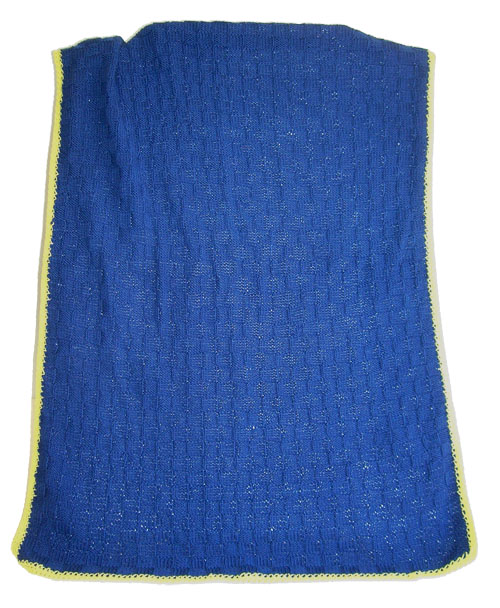
This easy to knit afghan is worked in a simple checkerboard pattern and is trimmed in a crocheted contrasting color of the same yarn.
The checkerboard pattern stitch does not curl so that the trim is optional.
 
We use Bali for many of our baby afghans because it is so soft and cuddly.


SKILL LEVELS FOR KNITTING

skill_gingham.jpg
     

  Beginner
Projects for first-time knitters using basic knit and purl stitches. Minimal shaping.

skill_gingham.jpg
skill_gingham.jpg
   

  Easy
Projects using basic stitches, repetitive stitch patterns, simple color changes, and simple shaping and finishing.

skill_gingham.jpg
skill_gingham.jpg
skill_gingham.jpg
 

  Intermediate
Projects with a variety of stitches, such as basic cables and lace, simple intarsia, double-pointed needles and knitting in the round needle techniques, mid-level shaping and finishing.

skill_gingham.jpg
skill_gingham.jpg
skill_gingham.jpg
skill_gingham.jpg

  Experienced
Projects using advanced techniques and stitches, such as short rows, fair isle, more intricate intarsia, cables, lace patterns and numerous color changes.


YARN AND AMOUNT: 6 balls of Bali in Main Color
                                 1 ball of Bali in Contrasting Color
   
GAUGE: 22 stitches and 28 rows = 4 inches in stockinette stitch
   
NEEDLES: size 6
   
YARDS: 159
   
CONTENT: 50% cotton, 50% acrylic
   
CARE: machine wash and dry gentle cycle


GGH_bali_color_bars.jpg